Starting out
Choose a surf lesson for your first day in the water
Find a first lesson whose meeting arrangements, equipment and teaching format leave you ready to learn, rather than trying to solve everything on the beach.
Starting out
Wind direction only becomes meaningful when you relate it to the beach orientation, the forecast's notation and current local advice.
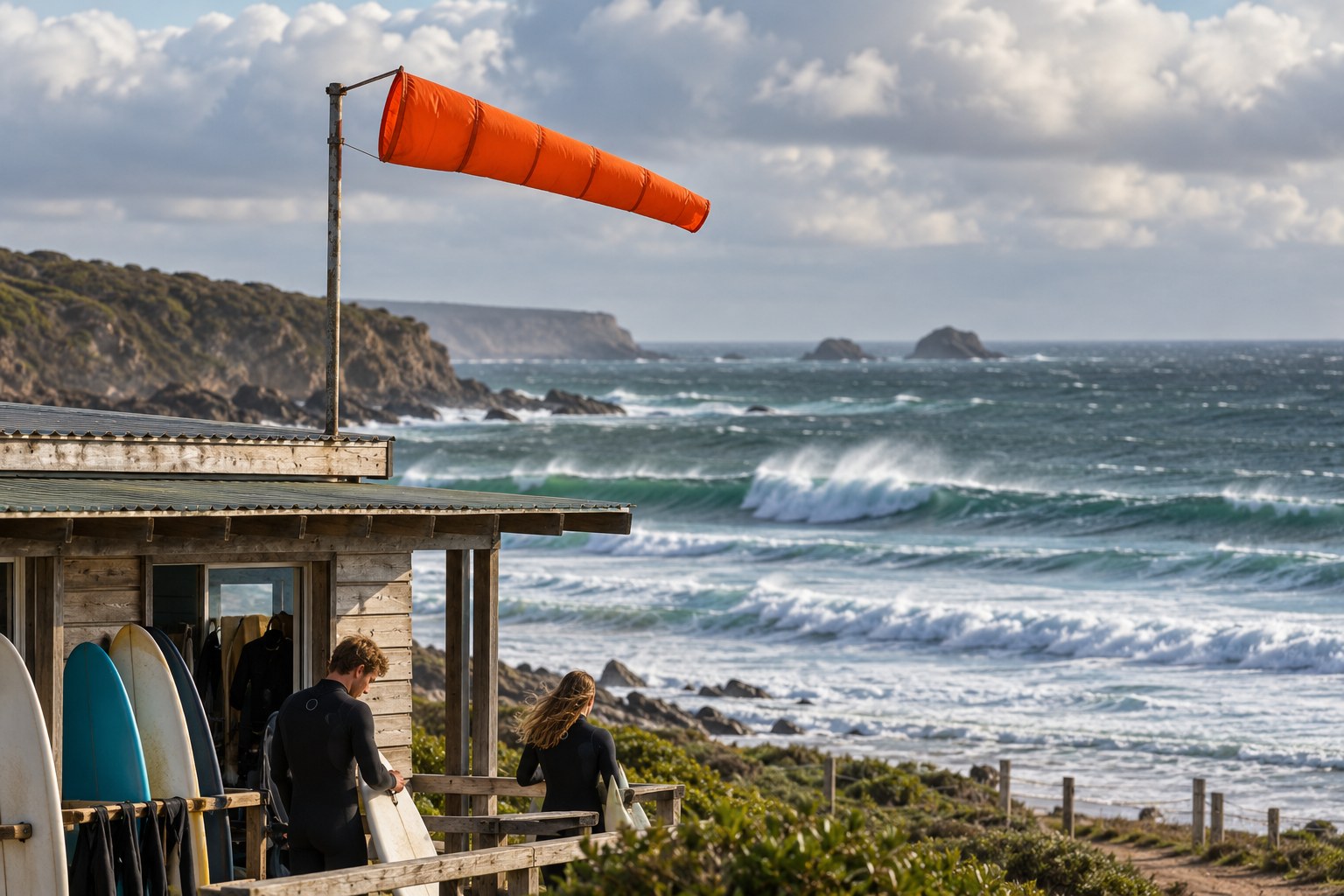
AI-generated illustration. Equipment details are illustrative; follow the instructions for your own item.
Onshore and offshore describe wind relative to the coast, not fixed points on a compass. Offshore wind blows from land towards the sea; onshore wind comes towards the land. The same compass direction can therefore have a different relationship to two beaches facing different ways.
The Met Office notes that wind strength and direction can change during the day. Read the relevant time window and any gust information, rather than saving a morning arrow and treating it as the afternoon's conditions too. A favourable-looking description in a surf report is not a judgement that the water suits your ability.
Different displays use arrows and labels in ways that are not always obvious at first glance. Read the legend to establish whether an arrow indicates where wind is coming from or where it is going. Avoid rotating a map in your head and guessing when the service provides an explanation.
Identify the actual beach orientation on a map. A curved bay can have sections facing differently, and a place name may describe the whole bay. Ask which section a local report refers to before using it to plan a meeting point.
Keep wind separate from swell direction. They can appear next to each other on a forecast screen but describe different information. If your note says only “west”, it may be impossible later to remember which one you meant.
Wind affects the land part of a visit as well. Ask the school where the group will meet if an exposed car park is uncomfortable and how equipment will be carried. Plan clothing for time spent waiting rather than judging the whole day by the water temperature alone.
Do not choose a beach solely because an article describes offshore winds as desirable for wave shape. That description does not account for your experience, equipment or the strength of the wind. Have the current situation assessed locally and follow official warnings and the instructor's directions.
When comparing a report with what you see on arrival, ask about any difference instead of trying to force one to match the other. A report may be old, refer to another section or summarise a changing day. The useful habit is checking the location, timestamp and meaning before allowing a compact icon to dictate the plan.
Starting out
Find a first lesson whose meeting arrangements, equipment and teaching format leave you ready to learn, rather than trying to solve everything on the beach.

Starting out
Get clear answers about teaching, equipment and changes of plan before a surf school turns a provisional enquiry into a booking.