Boards & equipment
Soft top or hard board for your first purchase
Choose construction alongside shape, condition and the way you will use the board, rather than treating a hard board as an automatic upgrade.
Boards & equipment
The nose is easy to recognise in a product picture, but its outline should be read alongside the rest of the board.

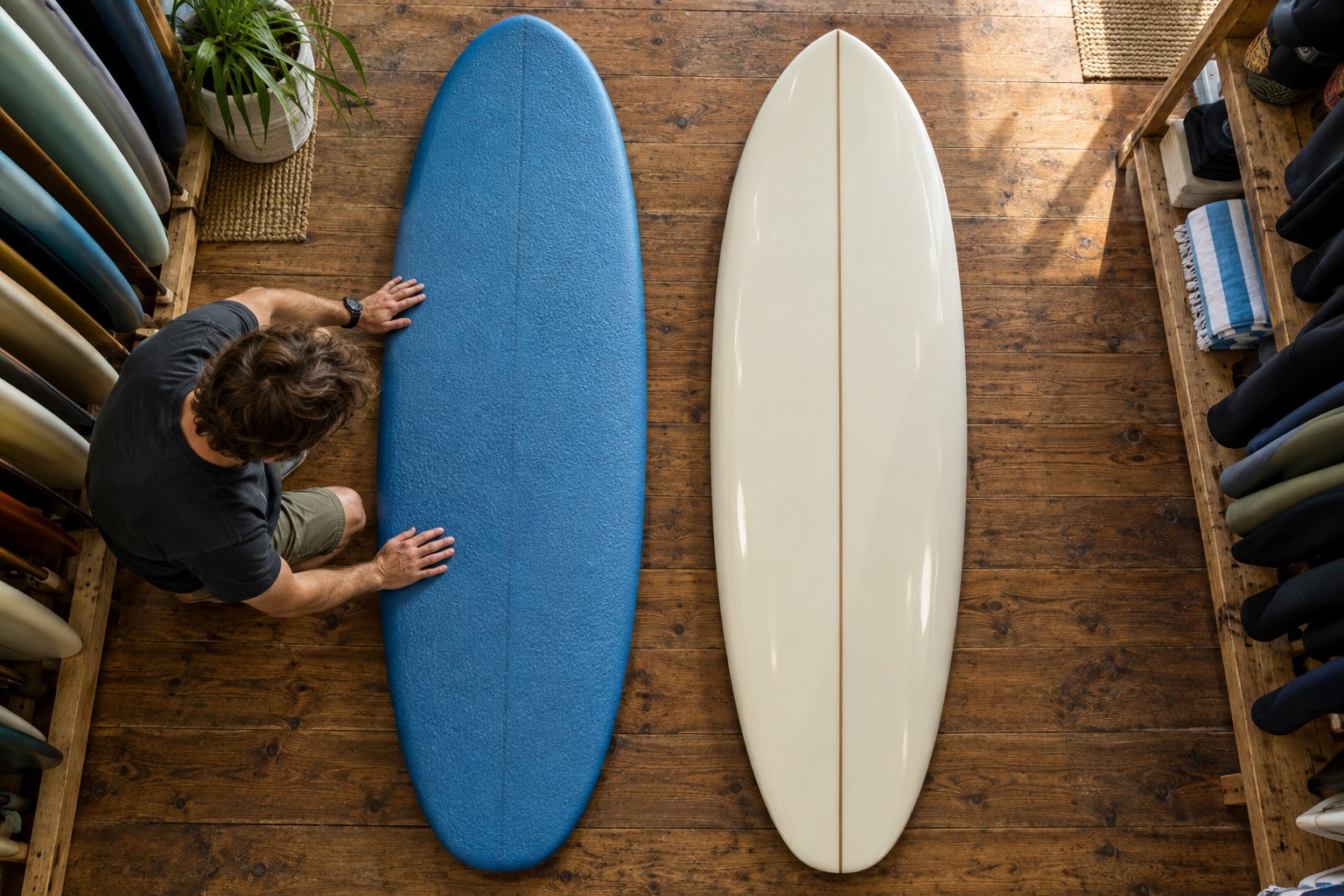
A rounded nose and a pointed nose can make two surfboards look immediately different. The distinction is useful for describing what you see, but it is not enough to select a board. Overall length, width distribution, rocker and intended use still need to enter the conversation.
Broad, rounded noses often appear on learner-oriented long shapes, while pointed noses are common on performance shortboards. There are many variations between those examples. A compact board with a full nose is not automatically a beginner board, and a narrow tip does not tell you how a model will behave by itself.
Look beyond the last few centimetres. How quickly does the outline widen? Where is the widest part of the board? Does the nose carry substantial thickness or taper towards a thin edge? Ask a shop adviser to explain those features as part of the model's intended use.
Photographs can exaggerate or flatten these differences. A board shot from close to the nose may look much broader at the front than it does in person. Use a consistent overhead image and the manufacturer's specification when building a shortlist, then inspect the actual board where possible.
Do not choose a pointed nose because it looks more advanced or a rounded nose because it appears universally forgiving. Those are visual shortcuts that bypass the important question: does the whole design suit the sessions you are ready to undertake?
When comparing bags, check the nose shape as well as the stated length. A narrow bag can be unsuitable for a fuller outline even if the length seems correct. Ask the bag maker which board shapes it accommodates and consider any padding needed for the intended journey.
Handle every nose carefully around people, doors and vehicles. A rounded shape does not remove the consequences of an impact, and a soft surface does not make a board harmless. Ask your instructor how to manage the board during the lesson rather than relying on its appearance.
If you are replacing a known board, record what you liked about it and what you want to change. Let that practical history guide the discussion. The nose shape can help identify a design, but it should remain one part of the explanation for buying it.
Boards & equipment
Choose construction alongside shape, condition and the way you will use the board, rather than treating a hard board as an automatic upgrade.

Boards & equipment
Bring a record of the boards you have used and the sessions you want to your sizing conversation.