
Boards & equipment
Choose a board length with help from a local instructor
Bring a record of the boards you have used and the sessions you want to your sizing conversation.
Boards & equipment
Choose construction alongside shape, condition and the way you will use the board, rather than treating a hard board as an automatic upgrade.
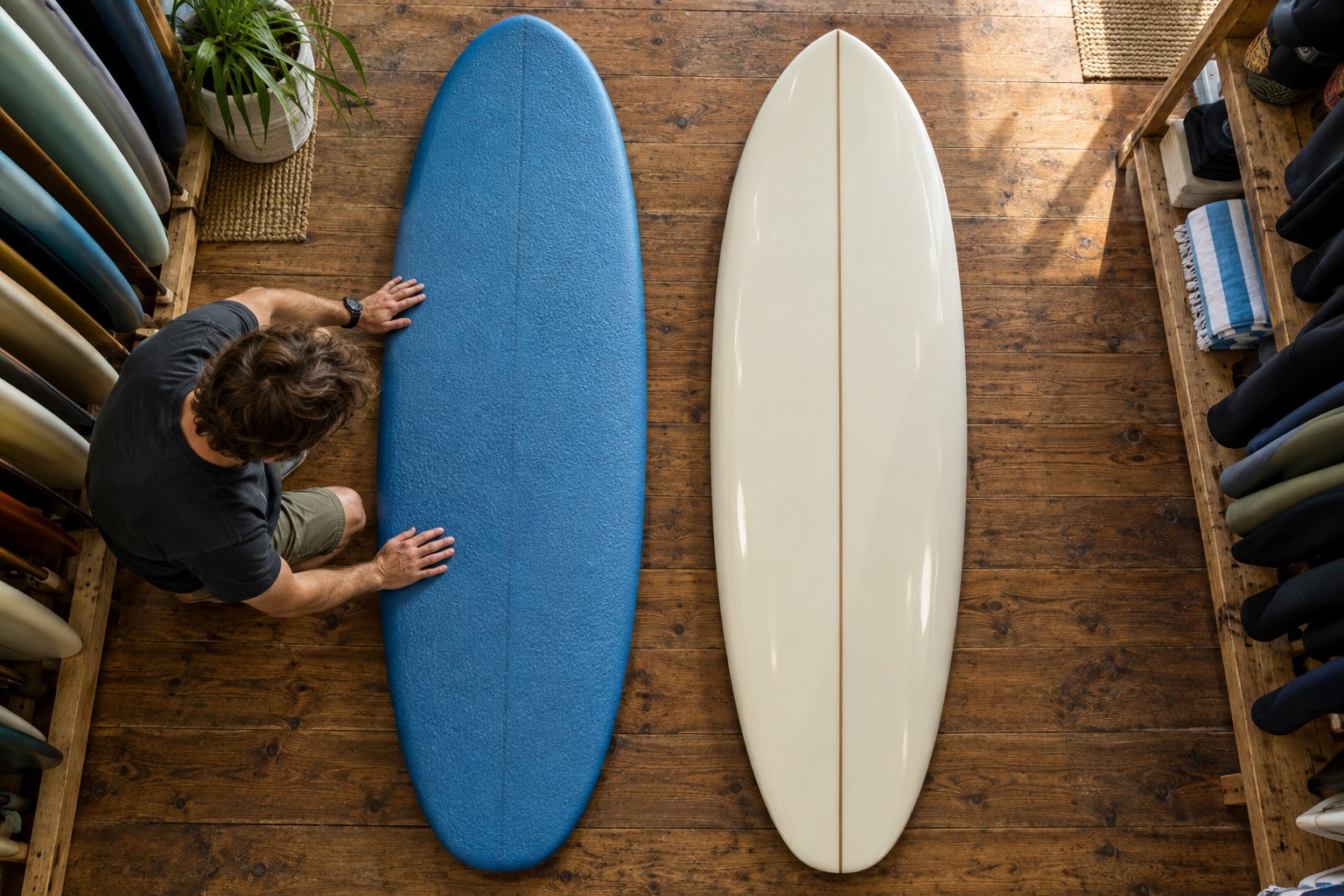
AI-generated illustration. Equipment details are illustrative; follow the instructions for your own item.
The decision between a soft top and a hard board is often framed as a beginner-versus-progressing choice. That is too simple. Softboards include both learner shapes and performance models, while hard boards come in many outlines and sizes. Construction is one part of a purchase that also involves your current ability, local sessions and the board you have already used successfully under instruction.
Start with that experience. Write down the model and dimensions of your lesson or rental board and ask the instructor what made it appropriate. If you are considering a change, ask what problem the new board is intended to solve. A different surface or graphic is not itself an answer.
Compare length, width, thickness, outline and fin arrangement. A shorter softboard does not necessarily preserve the characteristics you liked in a larger learner board. Softech explicitly separates models intended for learners from those aimed at intermediate and advanced surfers, so the soft surface should not be read as a universal ability label.
For a hard board, establish the construction rather than using the word fibreglass as a complete description. Ask the maker or shop which care and repair instructions apply. You do not need to become a materials specialist, but you should know where to find the correct guidance if the outer surface is damaged.
Handle both options with the staff member. Consider whether you can carry the board along your actual route and store it without pressure on vulnerable areas. A board that fits your surfing needs still needs a workable life between sessions.
Check whether fins are included and what type of leash, bag or storage arrangement is needed. A board-only price can look attractive until the missing parts are added. Avoid buying a bundle simply because it appears complete; each included item still needs to suit the board and your use.
Ask about the availability of replacement fins and fittings. Some softboards use particular attachment systems, while other models accept a named removable-fin standard. A familiar-looking fin does not establish compatibility. Photograph the fittings and save the model information with the receipt.
Think about repair support near where you live. If damage occurs, can a local repairer assess that construction, or will you need to contact the maker? Do not assume a soft top can be ignored when cut or a hard board can be patched with any resin sold online.
If the proposed board represents a significant change, ask about a supervised trial or suitable rental. Keep the comparison focused: you are trying to understand whether that model works for your present sessions, not trying to prove you deserve a different category of board.
Take the trial notes back to the instructor or shop. Explain what you found manageable and what became difficult. Avoid drawing a permanent conclusion from one unfamiliar attempt in different conditions, especially if several design features changed at once.
There is also a valid third option: continue renting while you clarify the choice. That can be more useful than buying a board now and replacing it shortly afterwards. Purchase when you can explain why the particular board fits your current practice, how you will transport it and what care it requires. The material label should support that decision rather than make it for you.
Write the two candidate models in separate columns and add only information you can establish: suitability discussed with the instructor, included components, storage fit, transport method and local repair support. Leave an unknown item marked unknown. This prevents a persuasive product description from quietly filling gaps with optimistic assumptions.
Consider a learner who has used a school softboard but is offered a low-priced hard board by a friend. The friendly price does not answer whether its shape is suitable, whether damage needs assessment or whether it can be transported. Compare it with an appropriate softboard on those same questions before deciding that the construction change represents progress.
Alternatively, an experienced surfer may deliberately choose a performance softboard for a specific role. That purchase says little about which board a first-time learner should buy. Keeping those two examples separate helps avoid the idea that every surfer moves through one compulsory sequence of materials.
Keep a small portion of the budget available for the items the final choice actually needs. If the entire budget is spent on the board, a suitable bag or replacement component can become an afterthought. A complete, workable setup matters more than reaching the most expensive construction you can afford at checkout.
Boards & equipment
Bring a record of the boards you have used and the sessions you want to your sizing conversation.
Boards & equipment
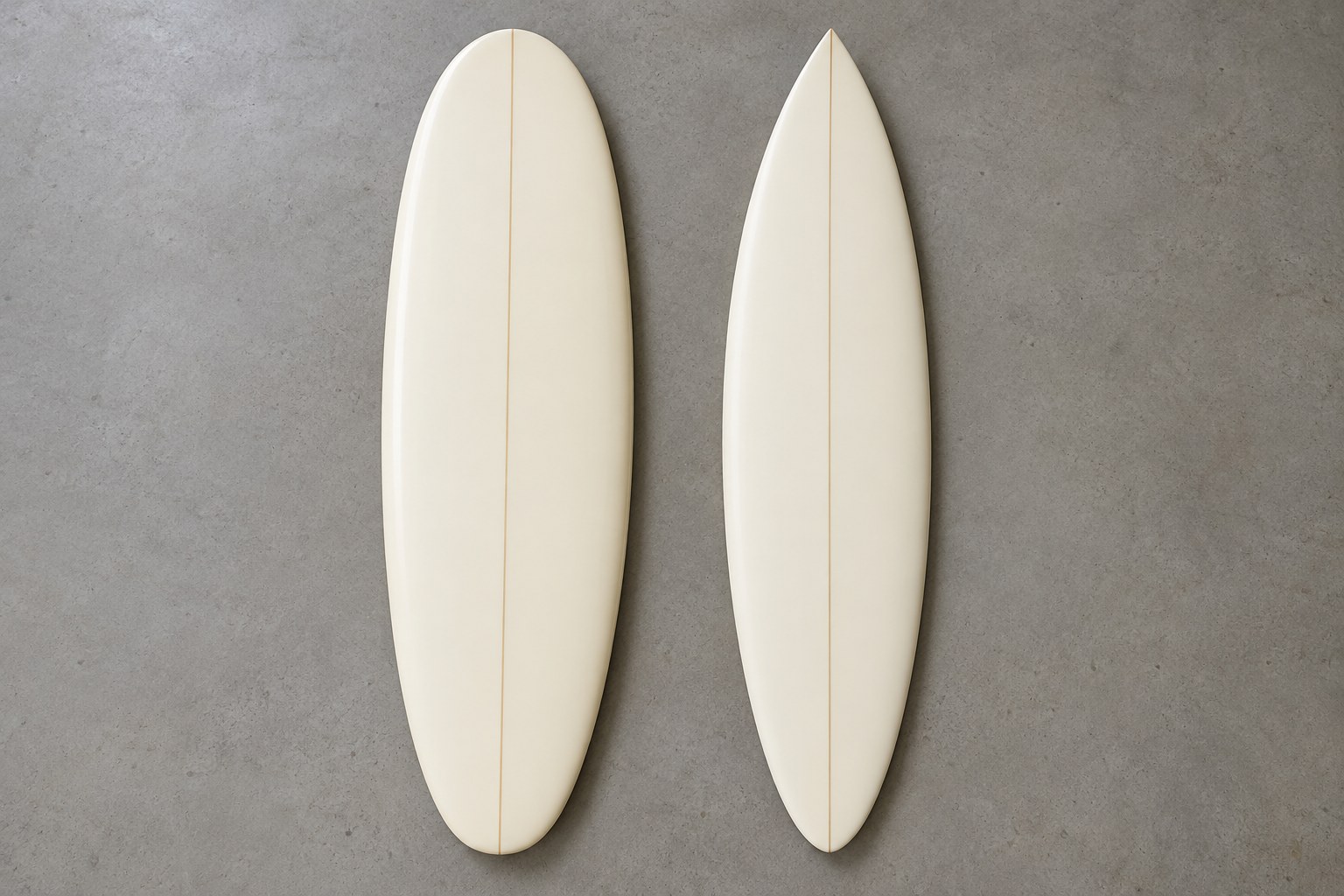
Look at where a board carries its width, not just the maximum measurement printed beside its length.