
Boards & equipment
Soft top or hard board for your first purchase
Choose construction alongside shape, condition and the way you will use the board, rather than treating a hard board as an automatic upgrade.
Boards & equipment
Make the leash a separate part of your equipment check, with enough time to replace a suspect component before the session.
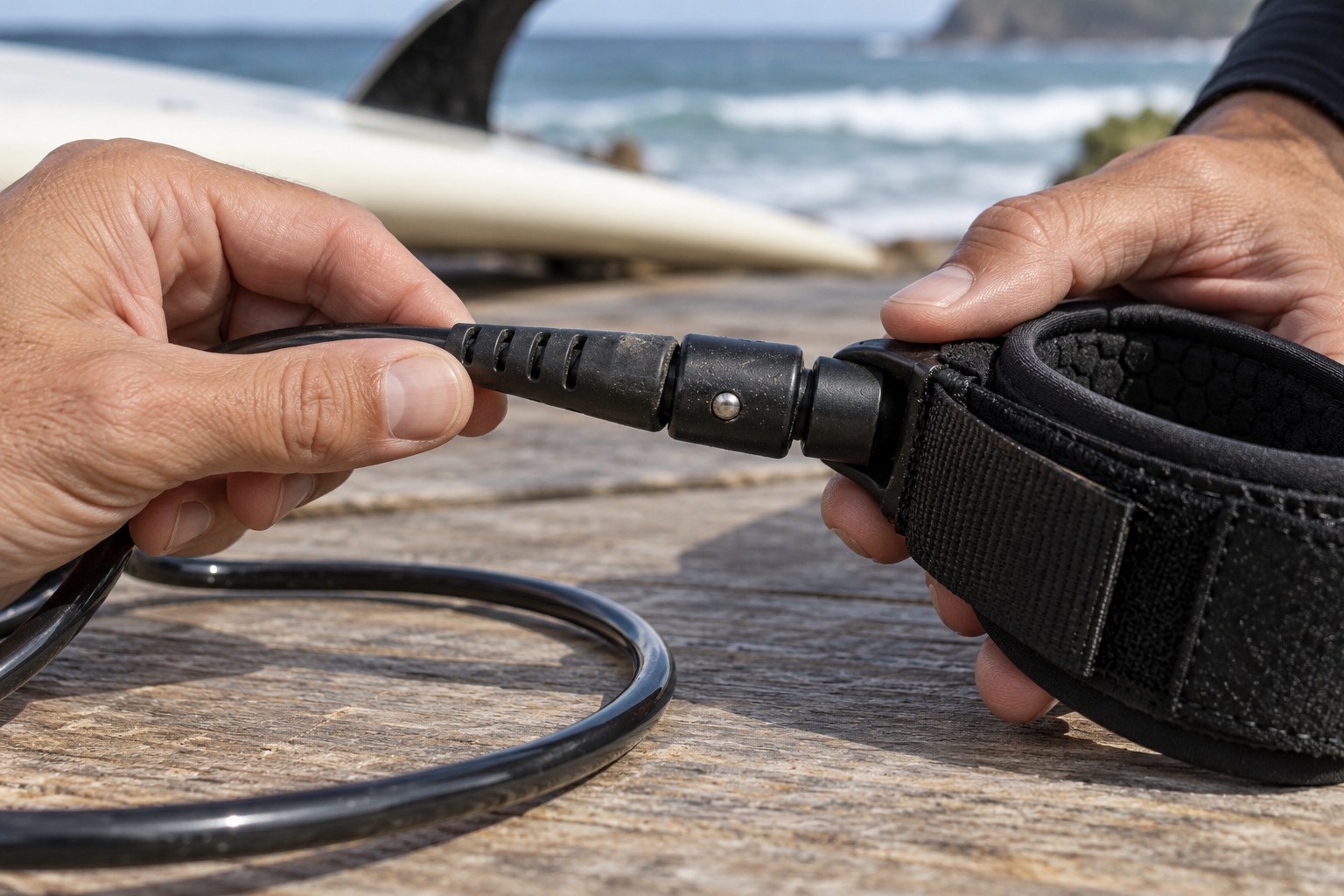
AI-generated illustration. Equipment details are illustrative; follow the instructions for your own item.
Lay the leash out where you can see the whole assembly without stretching it under load. Start at one end and work through the cuff, stitching, cord connections, swivels, cord and board attachment. A quick glance at the middle of the cord can miss a problem elsewhere.
Look for cuts, cracks, fraying, unusual changes in shape, damaged stitching or fittings that no longer move or close as described by the maker. If you do not know what normal looks like for that model, compare it with the instructions or ask a shop. Do not use a strong tug as proof that an uncertain leash is sound.
Check the board attachment and rail saver arrangement against the manufacturer's directions. A sound new cord does not resolve a worn string or damaged plug. If something appears loose or unfamiliar, stop and have it checked rather than tightening random parts until movement disappears.
Open the cuff and look at the closure surfaces. Sand and debris can interfere with a hook-and-loop fastening, while worn material may no longer hold properly. Follow the care directions and replace a closure that remains unreliable; a careful cleaning is not a repair for damaged fabric.
Examine the cord around connection points without sharply bending or twisting it. These areas can be less obvious than a visible nick midway along the leash. Any uncertain damage should be assessed before use, particularly if you cannot establish the equipment's history.
An old spare is useful only if it is suitable and in good condition. Inspect it too rather than assuming that being unused recently means it is ready. Label retired equipment so it cannot accidentally return to the active kit.
If you discover a concern at the beach, ask the school or shop about an appropriate replacement. Do not wrap tape over a damaged cord or stitch a cuff at the last moment as an improvised way to continue. Missing a session is preferable to treating uncertain equipment as a test case.
Record the model and purchase date when replacing a leash, and follow the maker's care and replacement guidance. An inspection can reveal visible problems, but it cannot guarantee against failure. Keep that limitation in mind when assessing the session itself and never rely on the leash as your sole means of staying safe.
Boards & equipment
Choose construction alongside shape, condition and the way you will use the board, rather than treating a hard board as an automatic upgrade.

Boards & equipment
Bring a record of the boards you have used and the sessions you want to your sizing conversation.