Boards & equipment
Soft top or hard board for your first purchase
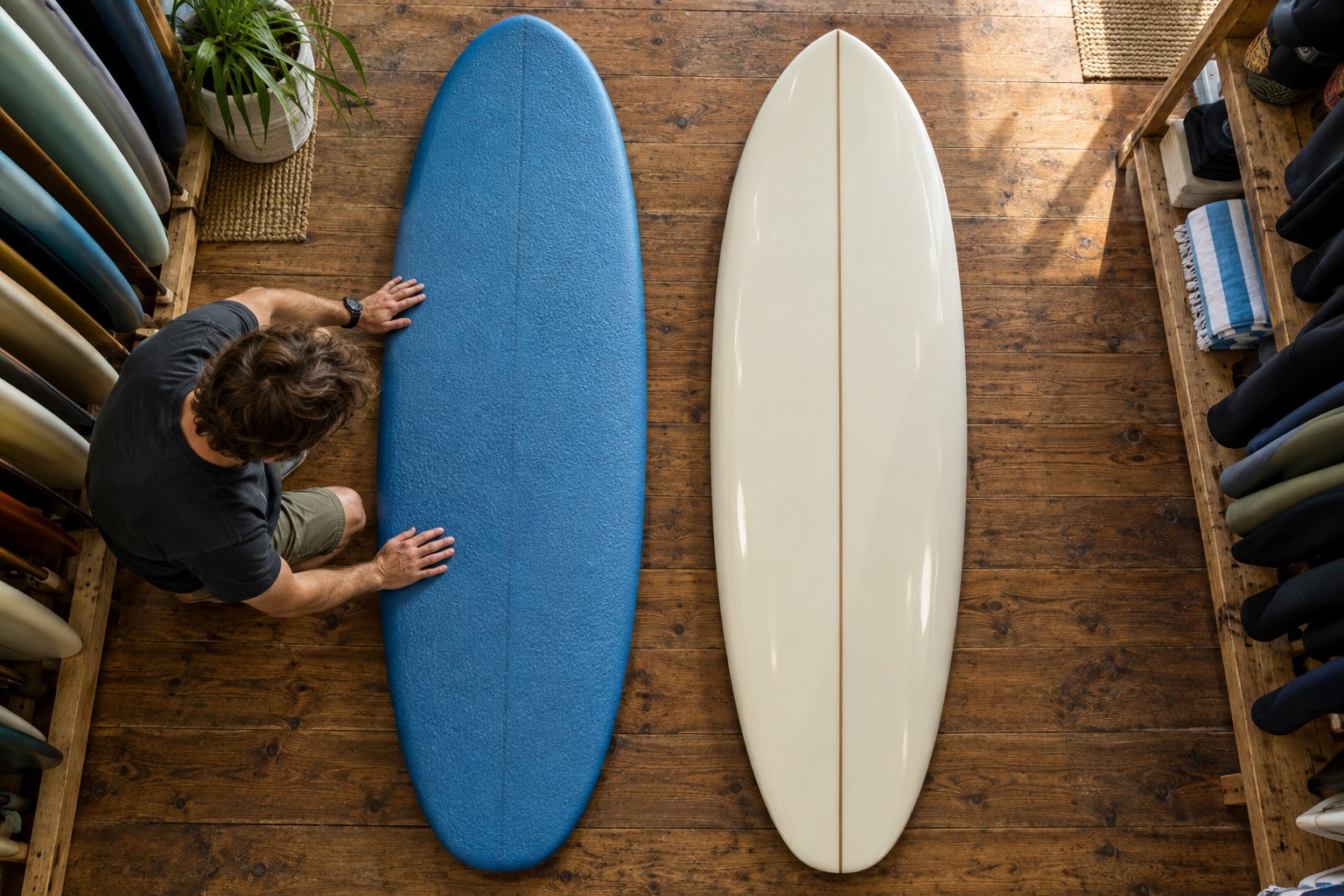
Choose construction alongside shape, condition and the way you will use the board, rather than treating a hard board as an automatic upgrade.
Boards & equipment
Inspect a used hard board in person where possible, and get uncertain damage assessed before the transaction becomes your repair project.
AI-generated illustration. Equipment details are illustrative; follow the instructions for your own item.
Begin a used-board viewing by confirming identity: maker, model, construction, dimensions and any serial or identifying marks. Compare those details with the listing. A board that looks similar to a current model may be an older version or a custom shape with different specifications.
Ask permission to inspect it in daylight or clear indoor light, supported properly. Look at the entire board before focusing on the obvious mark in the advertisement. A tidy deck photograph can leave the bottom, rails, tail and fittings almost entirely undocumented.
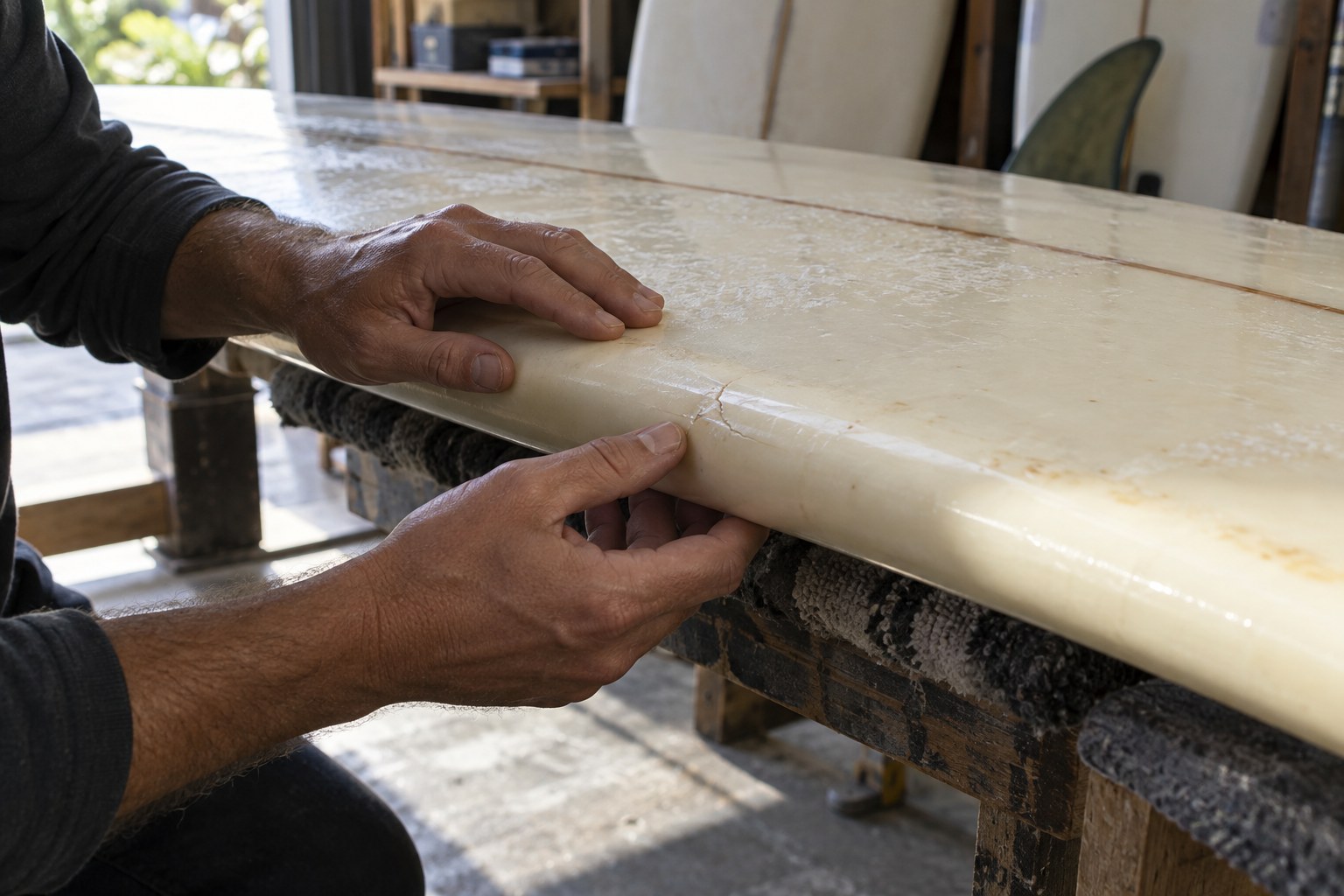
Look for cracks, open damage, areas of discolouration, unusual surface changes and previous repairs. Ask the seller to explain each one. A photograph cannot reliably establish whether a mark is superficial or whether there is damage beneath it, so avoid accepting a confident label without evidence.
Do not perform destructive tests. Pressing hard on a suspect area, levering a fin or bending the board can create damage and still fail to answer the underlying question. Have a competent repairer assess anything that affects your confidence in the structure or watertightness.
Wax and traction pads can obscure the surface. Ask what is visible beneath them and whether the seller can provide earlier photographs or allow an appropriate inspection. Do not remove attached items without agreement, and do not assume a covered area is sound because the rest looks clean.
Check the fin boxes, leash attachment and any vent according to the model's documentation. Look for signs of movement, cracking or previous work around them. Confirm that removable components are the correct type and that no improvised hardware has been fitted.
Ask where the board has been stored, how it has travelled and what repairs it has received. These answers do not prove condition, but they help frame the inspection. A seller who can identify the construction and provide a repair invoice gives you more to work with than one who says every mark is normal.
If the board includes fins, photograph their model and size. Evaluate whether they suit the board rather than treating any included set as equivalent value. A damaged box with an expensive fin installed remains a damaged box.
Get an assessment of uncertain work before agreeing a final price. Include replacement parts, a suitable bag and transport in your comparison. A low asking price can stop looking attractive when the board requires several visits to a repairer before use.
Keep a written record of the model, condition discussed and items included in the sale. This is particularly useful if collection happens later or a third party transports it. If you cannot establish the construction or the seriousness of a repair, choose another board rather than guessing your way into ownership.
Ask for a continuous set of recent photographs covering the deck, bottom, both rails, nose, tail and fittings. Request close views of every disclosed repair, with an ordinary object or ruler nearby when that helps show scale. Do not ask the seller to load or flex the board for a demonstration.
Compare the identifying marks across the images so you know they show the same board. A mixture of old promotional photographs and one current snapshot leaves too much unseen. Ask which images represent its present condition and whether anything has changed since they were taken.
Find out how collection or shipping will work and who will pack the board. A sound item can still arrive damaged if transport is poorly arranged. Agree what documentation accompanies it and how you will record its condition at handover. Read the actual sale and delivery terms rather than assuming a private sale operates like a retailer's return process.
If you cannot inspect it yourself, consider asking a competent local repairer or shop whether a paid assessment is possible before purchase. Confirm with the seller that they will make the board available for that purpose. An independent inspection costs something, but it can answer questions that a long exchange of messages cannot.
Finally, set a limit for uncertainty as well as price. If the seller cannot identify the board, avoids showing a damaged area or will not allow an agreed inspection, you do not need to resolve that uncertainty by buying it. Another listing with clearer information may be the more economical choice even if its asking price is higher.
Boards & equipment
Choose construction alongside shape, condition and the way you will use the board, rather than treating a hard board as an automatic upgrade.

Boards & equipment
Bring a record of the boards you have used and the sessions you want to your sizing conversation.