Surf travel
Choose a surf camp by its daily schedule
Read a sample day as a sequence of travel, instruction, meals and rest. The advertised number of lessons does not describe the whole holiday.
Surf travel
Measure the bag after packing, with its widest points and protruding parts included, rather than relying on the length printed on its label.
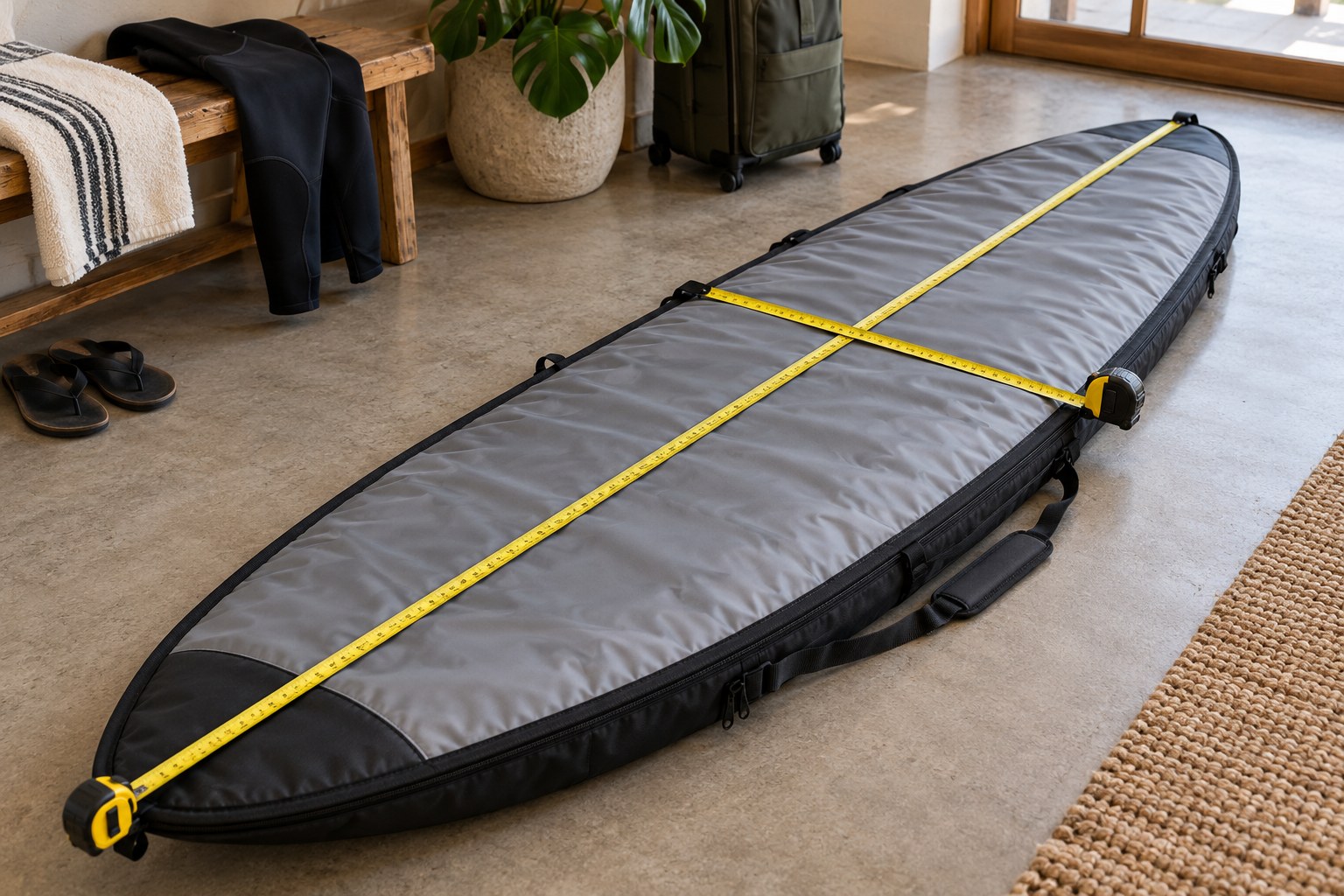
AI-generated illustration. Equipment details are illustrative; follow the instructions for your own item.
A board bag labelled for a particular board length describes what may fit inside it. It does not necessarily describe the outside dimensions that an airline will assess. Padding, wheels, handles and a thick stack of boards can change the final shape. Measure the actual load you intend to take.
Pack on a clear floor where the bag can lie naturally. Close it fully without compressing it with your knees or another person's weight. If the zip needs force, revisit the contents before treating the bag as ready for measurement. Leave any travel covers or external protection in the configuration you will use at the airport.
Measure the longest external distance, then the widest part, then the maximum depth. Include fixed protrusions according to the airline's measurement instructions. Do not assume a curved bag can be represented by measuring only the flat area between its seams. Use a second person to hold the tape straight if necessary.
Write the values with units. Keep centimetres and inches clearly labelled rather than mixing them in a calculation. Some policies describe each dimension separately; others use a combined measurement. Apply the calculation the carrier actually specifies, and preserve your original three measurements so they can be checked again.
Weigh the packed item with a scale suitable for its load. A bag that is difficult to suspend should not be balanced precariously over a fragile object. If a reliable measurement is not possible at home, arrange access to a suitable scale before departure rather than relying on a guess at check-in.
Make a short contents list and take a photograph of the finished arrangement. Adding a damp wetsuit, spare fins or a second towel later changes the weight and may change the dimensions. Whether personal items are allowed in an equipment bag is also a separate policy question.
On the return trip, repack deliberately rather than filling every remaining pocket with souvenirs. Check the same outer points and allow time to move permitted items into other luggage if needed. A measurement note is useful only while it describes the bag in front of you; it is not a permanent certificate for every future packing arrangement.
A soft bag can have more than one plausible measuring position. If the maker or airline requires a particular configuration, use it consistently and photograph that configuration. Do not squeeze an oversized pocket flat for the photograph and then refill it before departure. Where a limit is close, ask the carrier how it measures the item rather than assuming your own most favourable reading will be accepted.
For a group, label each measurement with the bag it describes. Two bags with the same printed board length can have different widths and depths. Keeping their weights separate also prevents a shared total from concealing one item that exceeds an individual limit.
Surf travel
Read a sample day as a sequence of travel, instruction, meals and rest. The advertised number of lessons does not describe the whole holiday.

Surf travel
Compare the room you will actually book, the shared facilities and the distance to the camp's meeting point rather than relying on a few attractive photographs.