Boards & equipment
Soft top or hard board for your first purchase
Choose construction alongside shape, condition and the way you will use the board, rather than treating a hard board as an automatic upgrade.
Boards & equipment
Add a second board only when you can describe a distinct role for it and accommodate the extra equipment between sessions.
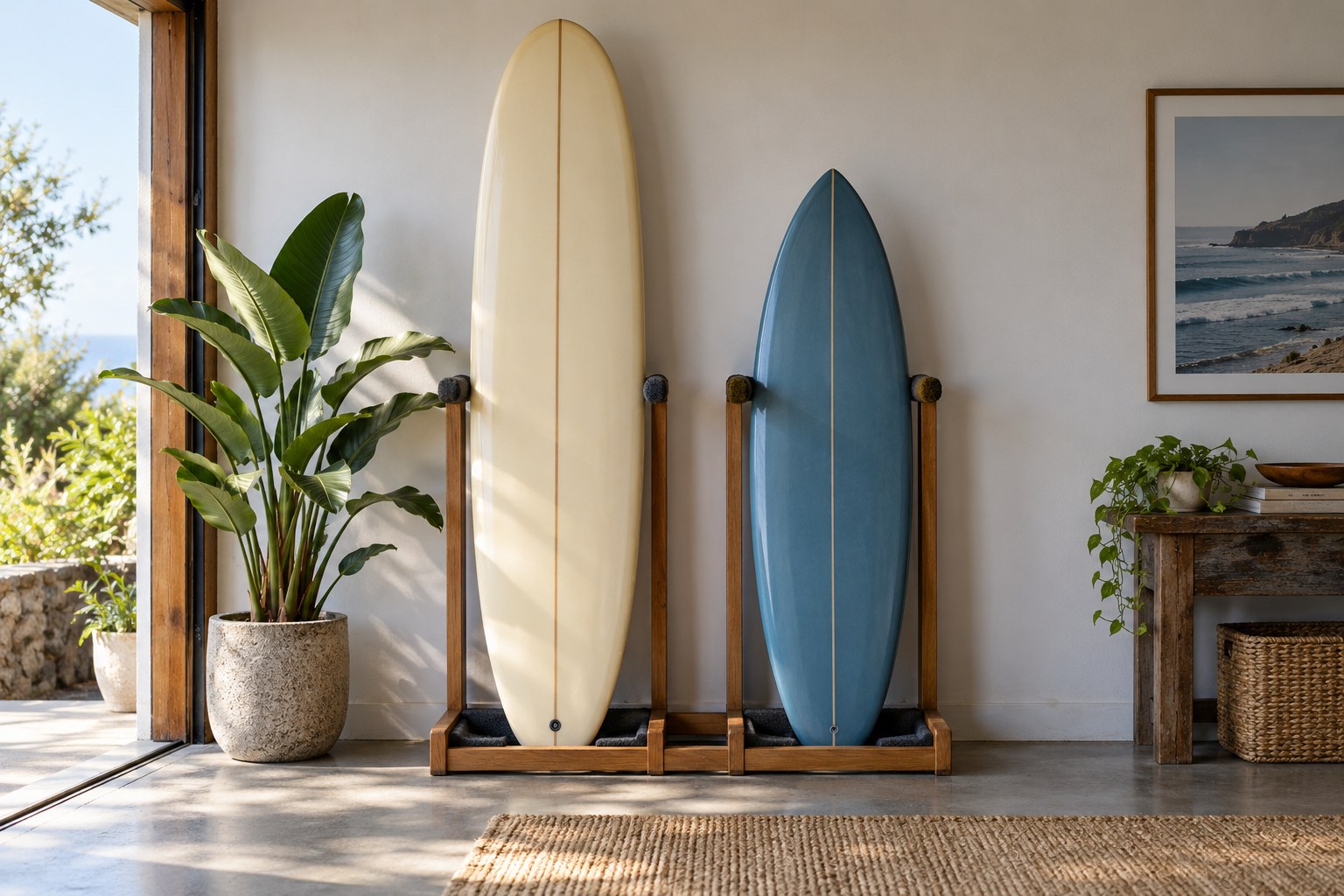
AI-generated illustration. Equipment details are illustrative; follow the instructions for your own item.
A two-board collection is useful when the boards serve identifiable purposes. Buying two similar boards because both are discounted can leave you with extra storage and maintenance without adding a meaningful option. Begin by recording what your current board already does well and where a different suitable design would fill a real gap.
Describe that gap in terms of sessions you can actually undertake. A board for an imagined future trip may sit unused while the one you need locally remains unchanged. If the new role involves conditions or skills beyond your present experience, discuss the plan with an instructor before shopping.
Write one sentence for each board. For example, one might remain the familiar board for regular supervised practice, while the other is a maker-recommended option being introduced through lessons. The sentence should describe use, not a prestige ranking such as basic board and serious board.
Ask whether renting would cover the occasional role more efficiently. A board used once during an annual trip brings transport, storage and care requirements for the rest of the year. Rental can be a sensible way to keep that option without owning every possible shape.
Do not assume accessories transfer. Check fin systems, leash requirements and bag dimensions for both boards. An existing bag that barely fits one outline may not suit the other even when their lengths are close.
Measure the storage arrangement with both boards in mind. Each needs appropriate support without leaning against vulnerable fittings or obstructing a doorway. Consider how you will remove one without knocking the other or putting it temporarily on a hard floor.
Think about travel as a complete load. Two boards may require a different bag or rack arrangement, and the packed weight can change transport options. Verify the relevant equipment limits rather than assuming that doubling the boards only adds a small inconvenience.
Keep separate records of dimensions, components and repair history. Label bags or accessory pouches discreetly if that prevents mixing incompatible parts. Before a session, choose according to the appropriate plan and current advice, not simply because the newer board has been waiting for a turn.
Revisit the collection after a season. If one board has no clear use, that is useful information. The aim is a set of equipment that supports your actual surfing, not a permanent obligation to justify every purchase.
Boards & equipment
Choose construction alongside shape, condition and the way you will use the board, rather than treating a hard board as an automatic upgrade.

Boards & equipment
Bring a record of the boards you have used and the sessions you want to your sizing conversation.