Boards & equipment
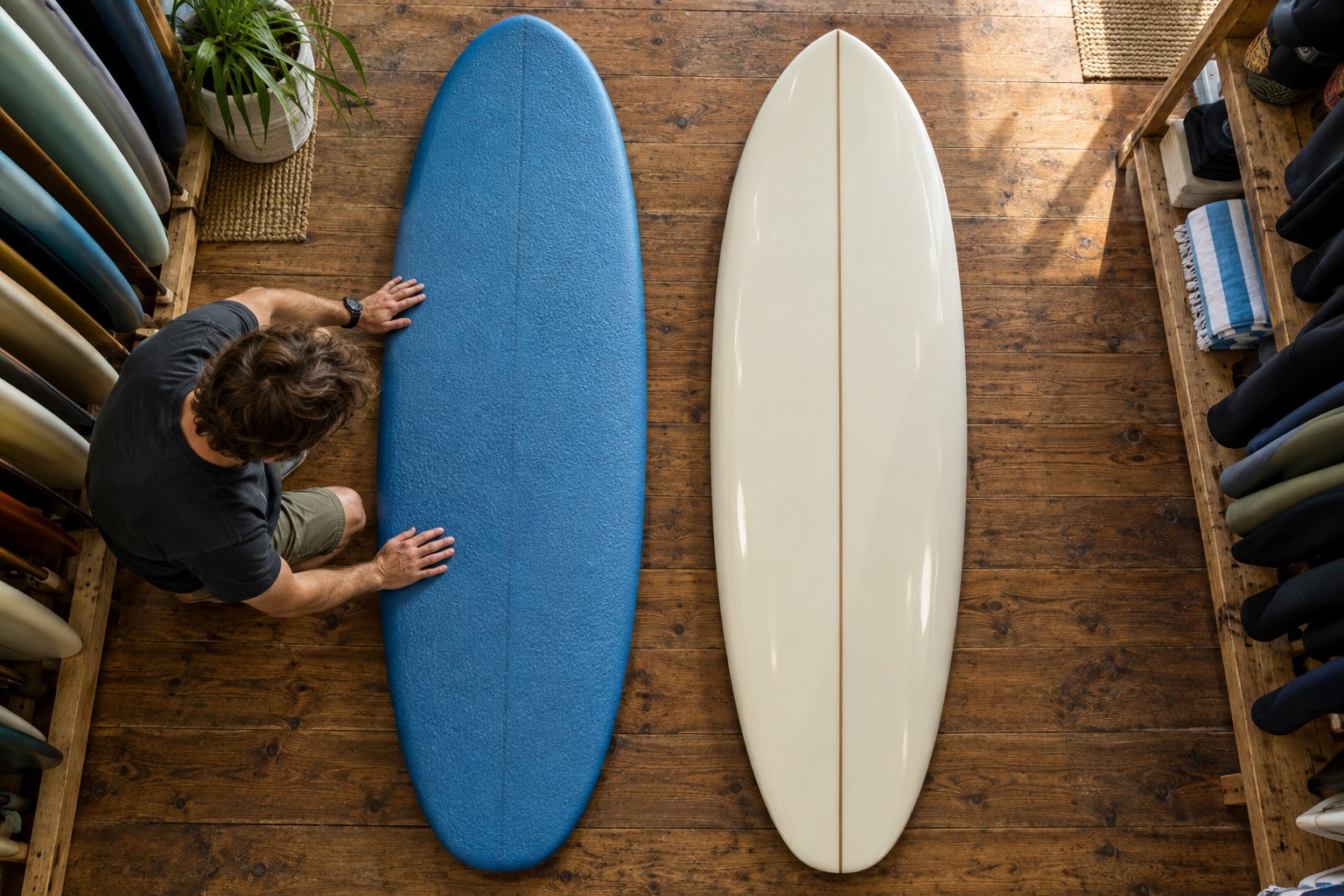
Soft top or hard board for your first purchase
Choose construction alongside shape, condition and the way you will use the board, rather than treating a hard board as an automatic upgrade.
Boards & equipment
Decide how many boards must travel together before comparing padding, dividers, wheels and the burden of one large bag.
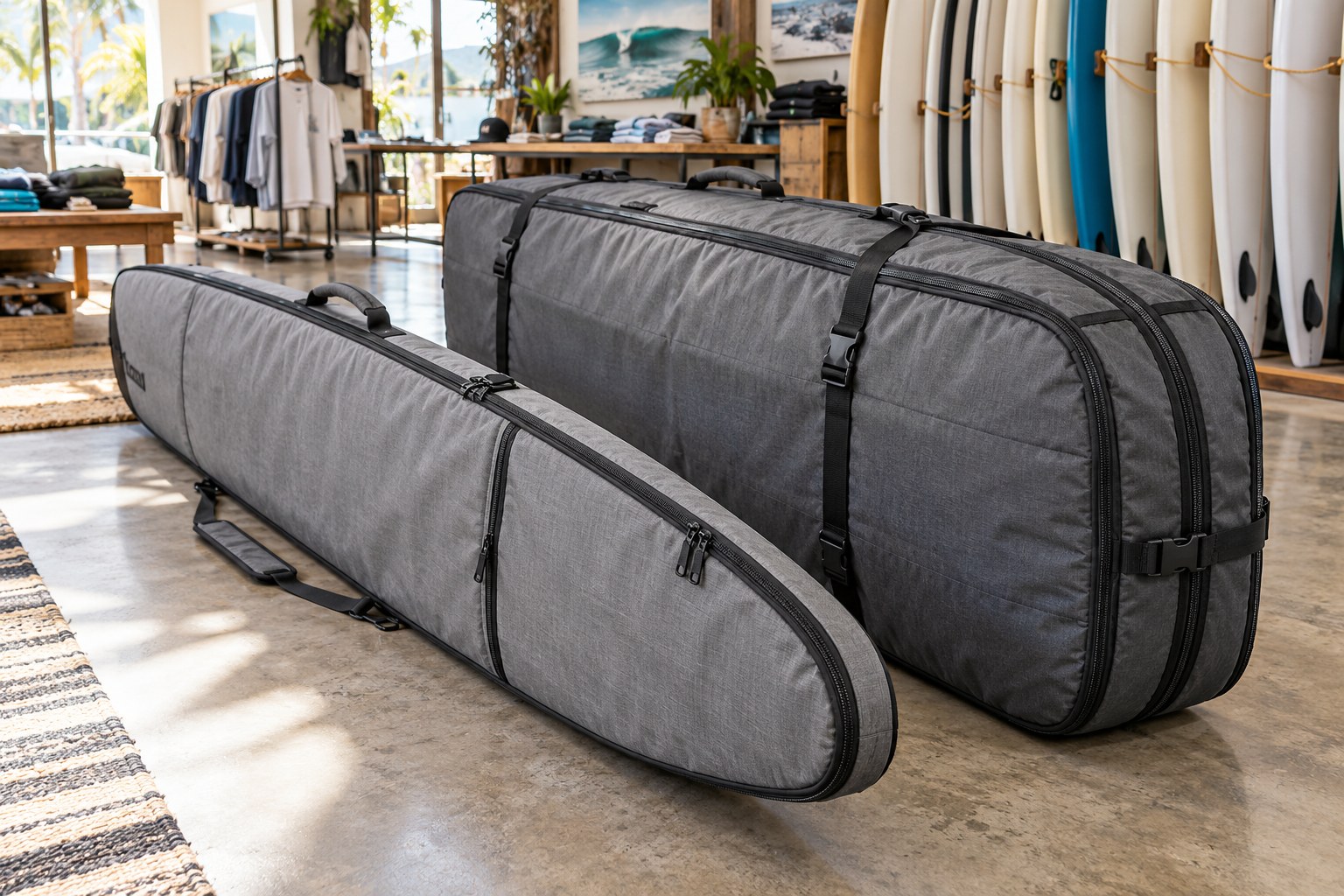
AI-generated illustration. Equipment details are illustrative; follow the instructions for your own item.
A multi-board bag can bring several boards into one piece of luggage, but the packed result may be difficult to lift, manoeuvre or fit into a transfer vehicle. A single-board bag keeps the load simpler, although travelling with several separate bags creates its own handling problem. Start with the boards you genuinely need for the trip, not the maximum number a bag could theoretically contain.
Lay out the proposed equipment and write down which board serves which purpose. If two boards fill the same role, reconsider carrying both before investing in a larger case. This is particularly useful when a rental option exists at the destination or when transport is arranged through a camp with specific vehicle limits.
A claim that a bag carries three boards does not mean three arbitrary boards. Check the maker's assumptions about length, width, thickness, fins and separators. Mixed shapes may pack differently from several similar shortboards. Provide the complete list to the retailer and ask for advice about the actual combination.
Look at how dividers are attached and whether they extend over the areas that need separation. Ask what is included and what must be purchased separately. A photograph showing an open bag can make a divider look substantial while giving little indication of how it stays in position when the luggage is lifted.
Think through the route from home to accommodation: stairs, a station platform, airport scales, a taxi, then possibly a narrow guesthouse entrance. Wheels may be useful on some of those surfaces, but the bag still needs to be lifted at other points. Check handle locations and make a realistic plan for assistance rather than relying on the longest smooth corridor.
The empty bag weight belongs in the comparison. So do the airline's current restrictions for the specific route and ticket. A bag's manufacturer capacity and an airline's allowance are separate limits; meeting one does not establish that the other is satisfied.
Suppose you plan to take one longer board for familiar sessions and one shorter shape for a different purpose. The bag's length must accommodate the longer board, but that still leaves questions about the space around the shorter one. Ask the bag maker how its dividers and internal restraints are intended to manage that combination. Do not fill unexplained gaps with hard luggage or assume that tightly compressing the contents provides the required protection.
Consider how you will repack at the destination. If one board is used while the other remains stored, you may need to remove and replace several layers each day. A bag that opens widely and allows you to identify each board's place could be more manageable than a compact design that must be emptied completely. Compare this access with the actual room or storage area you will use, following the maker's packing method throughout.
A single-board setup may leave more flexibility for an ordinary transfer and a small room. A multi-board setup may make sense for a trip built around several clearly different boards and transport arranged to match. Price the complete arrangement, including any vehicle upgrade, before deciding.
Finally, find a place to store the empty bag during the stay. A large case on the only bedroom floor can become a daily obstruction. Ask the accommodation where it can be kept, and leave enough time after returning home to check and dry the bag before folding it away.
Boards & equipment
Choose construction alongside shape, condition and the way you will use the board, rather than treating a hard board as an automatic upgrade.

Boards & equipment
Bring a record of the boards you have used and the sessions you want to your sizing conversation.