
Boards & equipment
Soft top or hard board for your first purchase
Choose construction alongside shape, condition and the way you will use the board, rather than treating a hard board as an automatic upgrade.
Boards & equipment
A thickness measurement identifies one dimension; it does not show how foam is distributed through the rails, nose and tail.
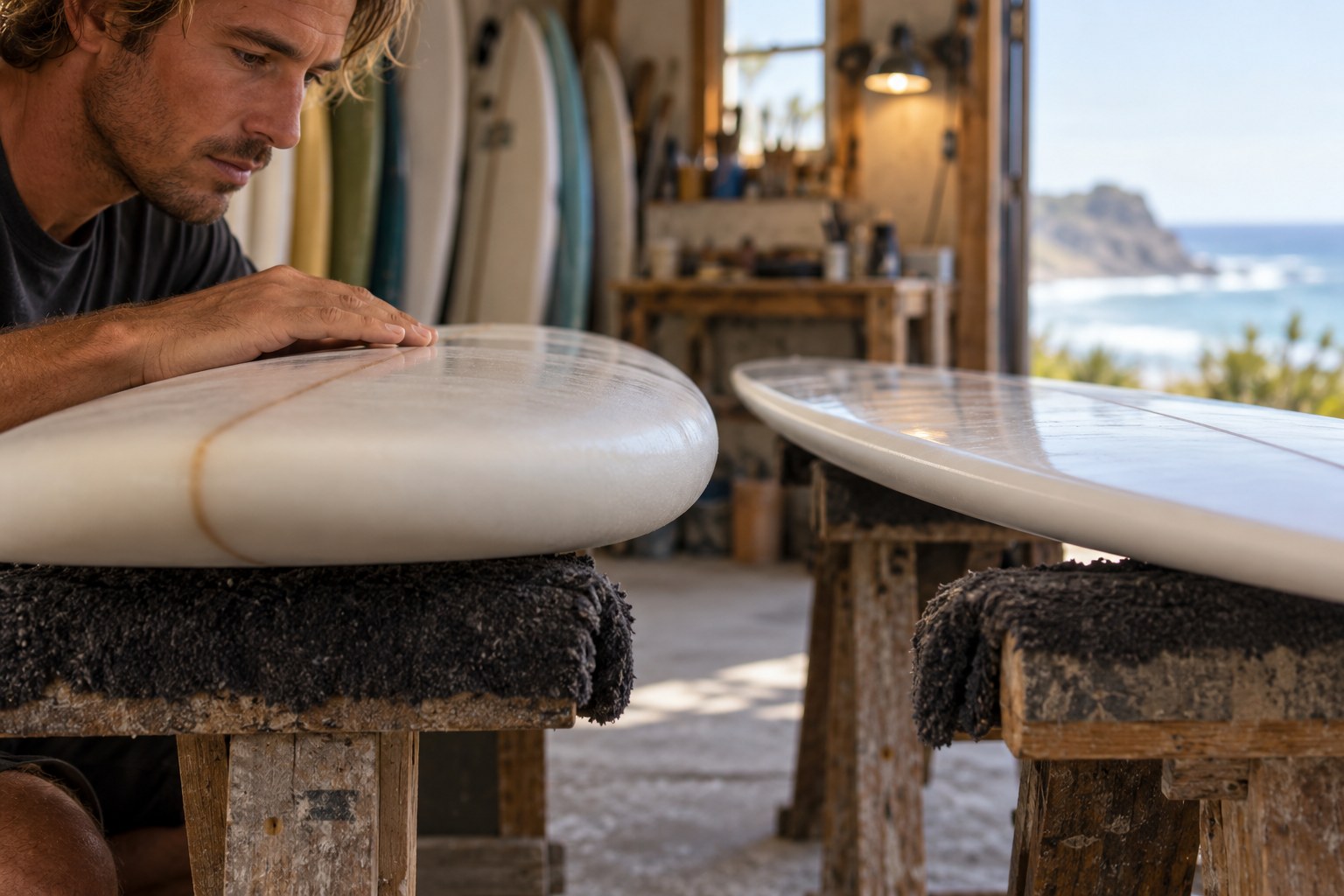
AI-generated illustration. Equipment details are illustrative; follow the instructions for your own item.
Surfboard dimensions commonly include a thickness figure alongside length and width. That number is useful for identifying a size, but it does not describe the full cross-section of the board. Two models with the same quoted thickness can have different decks, rails and thickness distribution along their length.
Look at the board from the side with a shop adviser. Ask where the stated measurement applies and how the shape changes towards the ends. There is no need to press the deck or squeeze the rails to investigate; the manufacturer's description and a careful visual comparison are better starting points.
Volume combines the three-dimensional shape, while thickness is one selected dimension. A thicker board is not automatically higher in total volume than every thinner board, because length, width and the rest of the shape also matter. Keep the full specification together when comparing models.
If a shop suggests a thicker size, ask what that change does within the particular model. Does it also change length or width? Is the suggested size intended for your weight and experience, or is it simply what is currently in stock? A clear explanation should connect the proposal to your use.
Avoid inventing a custom thickness from a small amount of experience. A shaper can discuss a custom board in the context of an entire design. Taking a favourite dimension from several unrelated boards does not guarantee those features will work together.
Bring the details of your lesson board or current board into the conversation. Explain what feels manageable and what you want to change, using observations rather than shape jargon you are uncertain about. For example, describe the difficulty you encounter rather than saying you need thinner rails because a review used that phrase.
If the board's printed specification is unclear, ask the maker or shop to identify it. Do not infer thickness from a photograph beside another board; camera angle and perspective can mislead. Likewise, the thickness of a padded bag says nothing about the board inside it.
Save the final model, construction and size when you buy. Those details help with future comparisons and replacement parts. The thickness figure becomes useful as part of that record, while the actual suitability of the board still depends on its whole design and your experience using it.
Boards & equipment
Choose construction alongside shape, condition and the way you will use the board, rather than treating a hard board as an automatic upgrade.

Boards & equipment
Bring a record of the boards you have used and the sessions you want to your sizing conversation.